How to Identify Gaps in Your Alarm Management System
Most alarm management system gaps sit between detection and response. Here are the five places they hide, and a two-minute way to find yours. (140 characters)

Ask a plant team whether their alarm management system works. Most will say yes. Then ask them to prove it, and the answers get vaguer.
That distance between confidence and evidence is where the gaps live. They rarely announce themselves. Instead, they surface weeks later as a slow response nobody can fully reconstruct.
Why alarm system gaps are hard to see
Gaps sit between systems rather than inside them. Each piece passes its own test.
The SCADA system detects the fault correctly. The radio network has coverage. An on-call list exists somewhere. But nobody has tested the handoffs between those three things end to end.
No single screen shows the full path from trigger to acknowledgement to resolution. So the weak point stays invisible until an incident exposes it.
The five places gaps hide
Working through these in order gives you a structured picture rather than a list of complaints.
1. Coverage. Ask two questions here. Does every critical event actually generate an alarm, consistently across systems and sites? And are operators buried in alarms that should never have been configured? Both problems trace back to the same missing step, which our guide to alarm rationalization explains in detail.
2. Delivery. One device is one point of failure. A critical alarm sent to a single phone is one dead battery, one dropped signal, or one break away from being missed.
3. Escalation. Do unacknowledged alarms move to the next responder automatically? And can you trace a single alarm from trigger through to resolution? Without that trail, you cannot prove response times, and you cannot improve what you cannot measure. Our post on automatic alarm escalation covers what good looks like.
4. Visibility and management. Can you see alarm activity across lines, shifts, and sites in one place? Can you manage users, roles, and access centrally? Multi-site operations usually find this gap when head office asks for numbers nobody can produce.
5. Resilience and scale. Does the alarm path keep working when a server or a network segment fails? And does it extend to the next plant without a rebuild? Resilience gaps stay hidden until the day something breaks, which is exactly when alarms matter most.
What the delay actually costs
Gaps in your alarm management system do not break equipment. Instead, they stretch the time between failure and response.
That stretch is measurable. The average plant now takes 81 minutes to get production running again after an unplanned stop, up from 49 minutes five years earlier.1 Detection and coordination account for a large share of that window.
Costs vary widely by sector. We break the numbers down in The True Cost of Unplanned Downtime by Industry.
Score your alarm system in two minutes
A full alarm audit takes weeks and usually needs a consultant. That is the right answer eventually. However, it is a poor first step when you are still deciding whether the problem deserves funding.
SeQent built the Alarm Health Scorecard for that first step. It is ten questions, takes about two minutes, and asks for no system data. You answer on a confidence scale, because the goal is to locate weak spots rather than produce an audit finding.
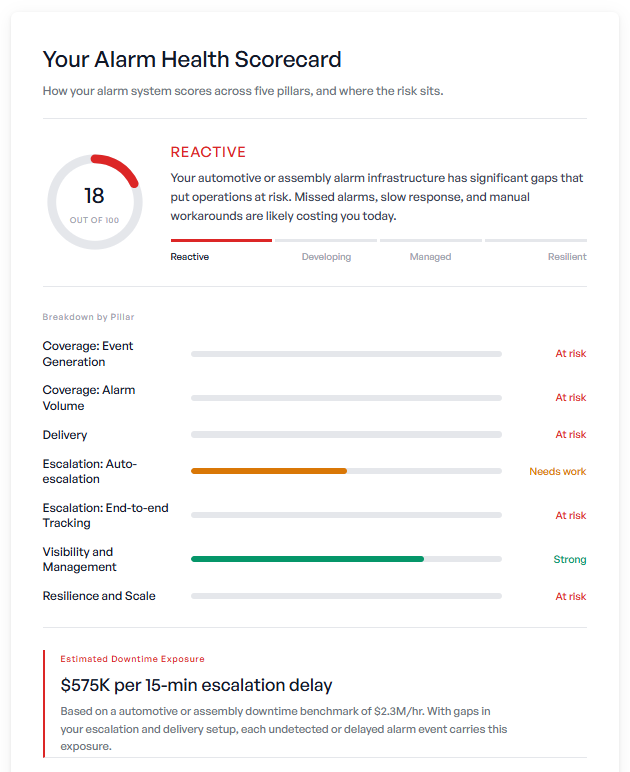
You get a score out of 100, a breakdown across the five pillars above, your top three risks, an estimated downtime exposure, and three recommended next steps. The exposure figure comes from published industry benchmarks rather than your own production data, so treat it as an order of magnitude.
The most useful result is usually the surprise: the pillar your team assumed was solid.
Find your weakest pillar
If you cannot say with confidence that every critical alarm reaches an acknowledged responder on more than one channel, you have a gap. The only real question is where it sits.
Score your alarm system in two minutes at seqent.com/alarm-scorecard. No sales call required.
Want to walk through your results? Book a review with a SeQent specialist and see how FirstPAGE Alarm Manager closes the gaps the scorecard finds.
Source
1. Siemens / Senseye Predictive Maintenance, The True Cost of Downtime 2024, Siemens AG, 2024. assets.new.siemens.com (PDF). Based on 181 completed online interviews with maintenance, engineering, and IT professionals at large industrial organizations in automotive, FMCG, heavy industry, and oil and gas, covering April 2019 to March 2023. Recovery-time figures verified against the primary report.