
Manufacturing Downtime: Causes, Costs, and Fixes
Manufacturing downtime is one of the largest controllable costs on the plant floor. Most unplanned stoppages are preventable, and the deciding factor is how fast the right person finds out.

What causes manufacturing downtime?
Downtime has many sources, but the most common include equipment failures, unaddressed alarms and faults, material or changeover delays, and slow response when something does go wrong. The last one is the quiet killer: a fault may be detected by a control system instantly, but if the alert sits unseen on a SCADA screen or an unheard overhead page, minutes tick by before anyone acts, and those minutes are lost production.

How much does downtime cost in manufacturing?
The true cost of downtime is more than idle machines. It includes lost production output, wasted labor, scrapped or out-of-spec material, expedited recovery, and missed delivery commitments. The exact figure varies widely by industry and line, but across manufacturing the cost of a single hour of unplanned downtime routinely runs into the tens or hundreds of thousands of dollars on high-value lines. Because the number compounds with every minute, shortening response time, not just preventing faults, has a direct and measurable payback.
Calculate your own cost
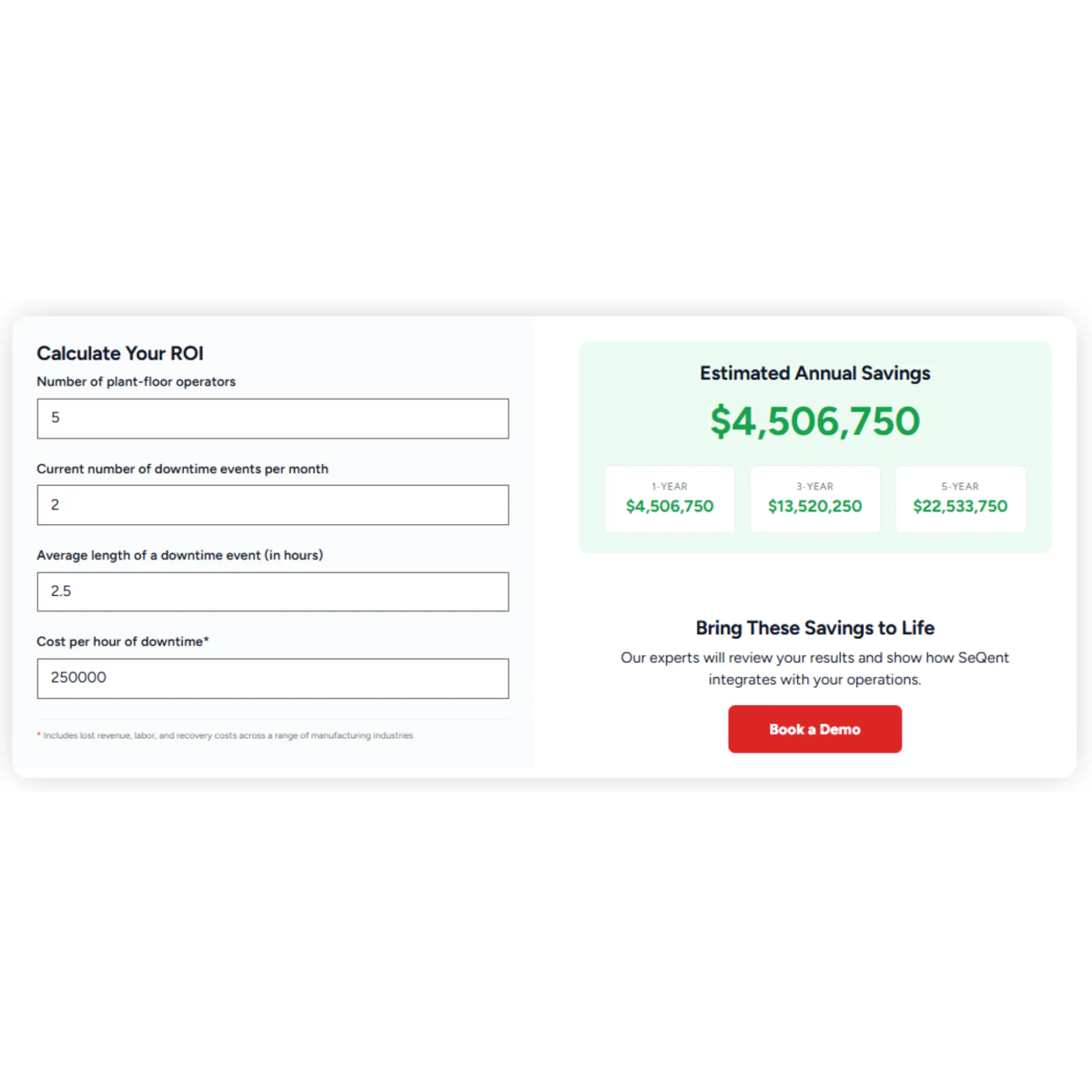
A simple way to size the opportunity: multiply your downtime hours by the fully loaded cost per hour for that line (lost output, labor, scrap, recovery). Even a modest reduction in response time, applied across a year of incidents, often returns far more than the cost of the systems that deliver it. SeQent’s ROI Calculator can help you estimate this for your own operation.
How do you reduce manufacturing downtime?
Reducing downtime is partly about preventing faults and partly about responding to them faster. On the response side, the highest-leverage change is closing the gap between detection and action, making sure that the instant a critical alarm fires, the right person is notified on a device they actually have with them, with automatic escalation if they don't respond.
Route alarms to people, not screens
Push critical alarms to mobile devices and two-way radios, not just a control-room display.
Escalate automatically
If the first responder doesn’t acknowledge, escalate to the next person, so nothing is missed on off-shifts.
Prioritize ruthlessly
Apply alarm management discipline so critical alerts aren’t buried under nuisance alarms.
Make status visible
Use real-time displays so the whole team sees problems as they develop.
Faster alarm response, less downtime.
More on downtime and alarm response



Manufacturing downtime questions, answered
Average CPG plants experience roughly 25 hours of unplanned downtime per month, or about 300 hours per year, at an average cost of approximately $23,600 per hour, according to Belden’s analysis citing Siemens data. Industry research finds that up to 72 percent of machine downtime is avoidable through better digital and notification strategies.
A one-hour unplanned outage at a leading-edge fab running 60,000 wafer starts per month represents approximately $2 million to $5 million in lost production value, plus any in-process lots scrapped and the labor required to recover and re-qualify the affected tools. A 24-hour outage at the same fab can approach $50 million to $100 million in combined direct and indirect impact, according to industry analysis.
Frequent SKU changeovers are a defining feature of CPG production. SeQent supports configurable alarm suppression during planned changeover windows, so operators aren’t flooded with nuisance alarms during setup, while critical safety alarms remain active. When the line resumes, SeQent routes alarms with the new SKU and shift context attached.
Alarm notification software for manufacturing monitors SCADA, MES, PLC, and equipment systems for alarm conditions, then routes alerts to the right person on the right device (two-way radios, smartphones, Andon displays, or overhead paging) with automatic escalation if no one acknowledges. It replaces manual dispatch so critical equipment faults, quality deviations, and safety events reach operators in seconds.
Find Your Downtime Gaps in a 15‑Minute Chat
Bring your downtime numbers, or your ROI Calculator result, and an alarm management expert will show you where response time is costing you production and what faster notification and escalation would change.
- See where alarms are being missed or delayed today
- Get a realistic estimate of preventable downtime for your lines
- Learn how escalation to radios and mobile devices fits your plant






By submitting this form, you agree to SeQent’s Privacy Policy.


