On-Premise vs. SaaS Alarm Notification: Which Model Actually Keeps Production Running?
For manufacturers running 24/7 operations inside tightly controlled OT networks, the choice between on-premise and SaaS alarm notification software comes down to one question: which architecture behaves predictably when line four goes down at 2 a.m. on a Saturday?

Every minute a critical alarm goes unacknowledged on your plant floor is a minute your production line is bleeding time, output, and margin. For operations teams managing complex SCADA and MES environments, the question isn’t whether to modernize alarm notification software. It’s which architecture will deliver the response speed and reliability your environment demands.
The debate around on-premise vs. SaaS industrial alarm management has intensified as more vendors push cloud-first solutions. But for manufacturers running 24/7 operations inside tightly controlled OT networks, the right answer isn’t always the one with the most polished interface. It’s the one that gets the right person the right alert in seconds. Every time, without exception.
Why Your Alarm Delivery Architecture Is a Downtime Variable
Most manufacturers have invested heavily in alarm rationalization, defining alarm limits, priorities, and escalation logic inside their SCADA or DCS. What they underinvest in is the last mile of alarm delivery: reliably bridging those events to the people who can act on them.
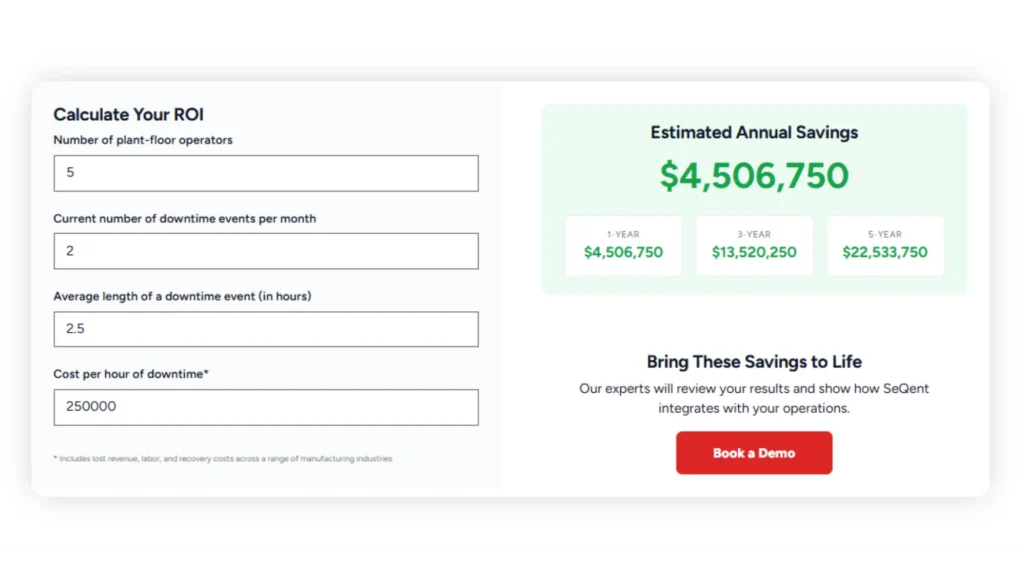
When alarms queue up in a control room HMI waiting for an operator who’s on the floor, or route through a cloud notification service that depends on plant internet connectivity, you’ve introduced a failure point between detection and response. That gap directly inflates your Mean Time to Repair (MTTR). For a closer look at what that gap actually costs, try SeQent’s Downtime ROI Calculator.
Consider what SeQent customers have seen across 350+ installations in facilities operated by manufacturers like Intel, Toyota, and Pfizer: when alarm notification is tightly integrated with existing OT infrastructure, including Motorola two-way radios, Andon displays, PA systems, and mobile devices, response times improve measurably. The technology that bridges that gap matters enormously.
On-Premise vs. SaaS Industrial Alarm Management: What’s Actually at Stake
Understanding the architectural trade-offs means looking beyond upfront cost and asking what happens when something goes wrong.
On-premise alarm management runs inside your plant network, adjacent to your SCADA and MES systems. This matters for several reasons:
- Network independence. Alarm delivery doesn’t depend on internet connectivity. A WAN outage doesn’t silence your floor.
- OT security posture. No alarm data traverses external networks. No external attack surface is introduced. For IT/OT convergence managers navigating ISA/IEC 62443 compliance, this is often non-negotiable.
- Deterministic behaviour. With on-premise systems, latency is bounded by your local network, not a cloud provider’s availability SLA or a congested internet segment.
- Deep integration. Direct connection to Rockwell Automation, AVEVA, Velotic, and other platforms without API rate limits or middleware abstractions.
SaaS alarm notification platforms offer faster initial deployment and lower upfront infrastructure cost. For low-criticality applications or environments with robust, redundant internet connectivity, they can be a reasonable fit. But in regulated industries and high-uptime manufacturing, including pharma, automotive, and semiconductor, the dependencies they introduce often outweigh the convenience.
The core question for controls and automation engineers isn’t “which is cheaper to start?” It’s “which behaves predictably at 2 a.m. on a Saturday when line four goes down?”
Where Integration Depth Separates Good Enough from Mission-Critical
One of the most overlooked dimensions in the industrial alarm management deployment decision is integration breadth. A notification system that only emails or texts is only as good as your operators’ phone habits. Real alarm-to-action speed requires reaching people through whatever device they’re actually carrying: a Motorola radio, a belt pager, or an overhead PA, not just a smartphone app.
SeQent Alarm Management was purpose-built for this reality. As a 15-year Rockwell Automation Technology Partner, SeQent Alarm Management connects directly to SCADA and MES alarm systems and fans out to two-way radios, smartphones, Andon displays, PA systems, and pagers from a single platform. That means your escalation logic, including who gets notified, in what order, and through which device, is configured once and executes reliably whether an operator is at a terminal or 400 feet away on the production floor.
This level of multi-channel alarm notification is exceptionally difficult to replicate with a SaaS-first architecture that wasn’t designed around OT protocols and plant-floor device ecosystems.
How to Make the Right Call for Your Facility
When evaluating on-premise vs. SaaS industrial alarm management, these are the questions that cut through vendor positioning:
- Can the system deliver alarms when your internet connection is down?
- Does it integrate natively with your existing SCADA, DCS, or MES, or does it require a middleware layer you’ll have to maintain?
- Does it support the physical devices your operators actually use, not just smartphones?
- Can your IT security team audit and control what data leaves the OT network?
- What is the vendor’s track record in environments like yours?
For most Fortune 500 manufacturers and regulated producers, the answers point clearly toward an on-premise architecture with proven OT integration depth.
SeQent has spent 30 years solving exactly this problem for industrial operations teams that can’t afford notification gaps. If you’re evaluating alarm management platforms, or questioning whether your current setup is actually closing the loop fast enough, let’s talk.
Schedule a demo with SeQent and see how SeQent Alarm Management performs inside environments like yours.